SECTION 00 / HEPTAPEPTIDE / MEHFPGP / MW 813.93 Da
Semax
A seven-amino-acid analog of ACTH(4-10), approved by prescription in the Russian Federation and Ukraine, unapproved by the FDA, EMA, MHRA, and Health Canada. This site indexes the published research record — Russian-language clinical trials, modern Western-journal mechanism studies, and the regulatory context that frames both.

SECTION 00 / THE SHORT VERSION
Semax (MEHFPGP) is a synthetic seven-amino-acid peptide developed in 1980s Soviet Russia from a fragment of the stress hormone ACTH. It is a prescription medicine in Russia and Ukraine — licensed for stroke, cognitive impairment, and optic-nerve disease — and an unscheduled research chemical in the United States, European Union, and United Kingdom. No FDA or EMA approval exists. In rats and mice, Semax reliably raises brain growth factors called BDNF and NGF, shrinks stroke-damaged brain tissue, and calms post-ischemic inflammation. The intact peptide clears the brain in minutes; longer effects are attributed to a breakdown product called Pro-Gly-Pro (PGP). Research-community users report a quiet mental clarity distinct from stimulants — but a real share feel nothing, the effect fades within hours, and the Russian clinical record has not been replicated in Western controlled trials. What people report, including the downsides, is laid out on the Semax effects page.
SECTION 01 / WHAT SEMAX IS
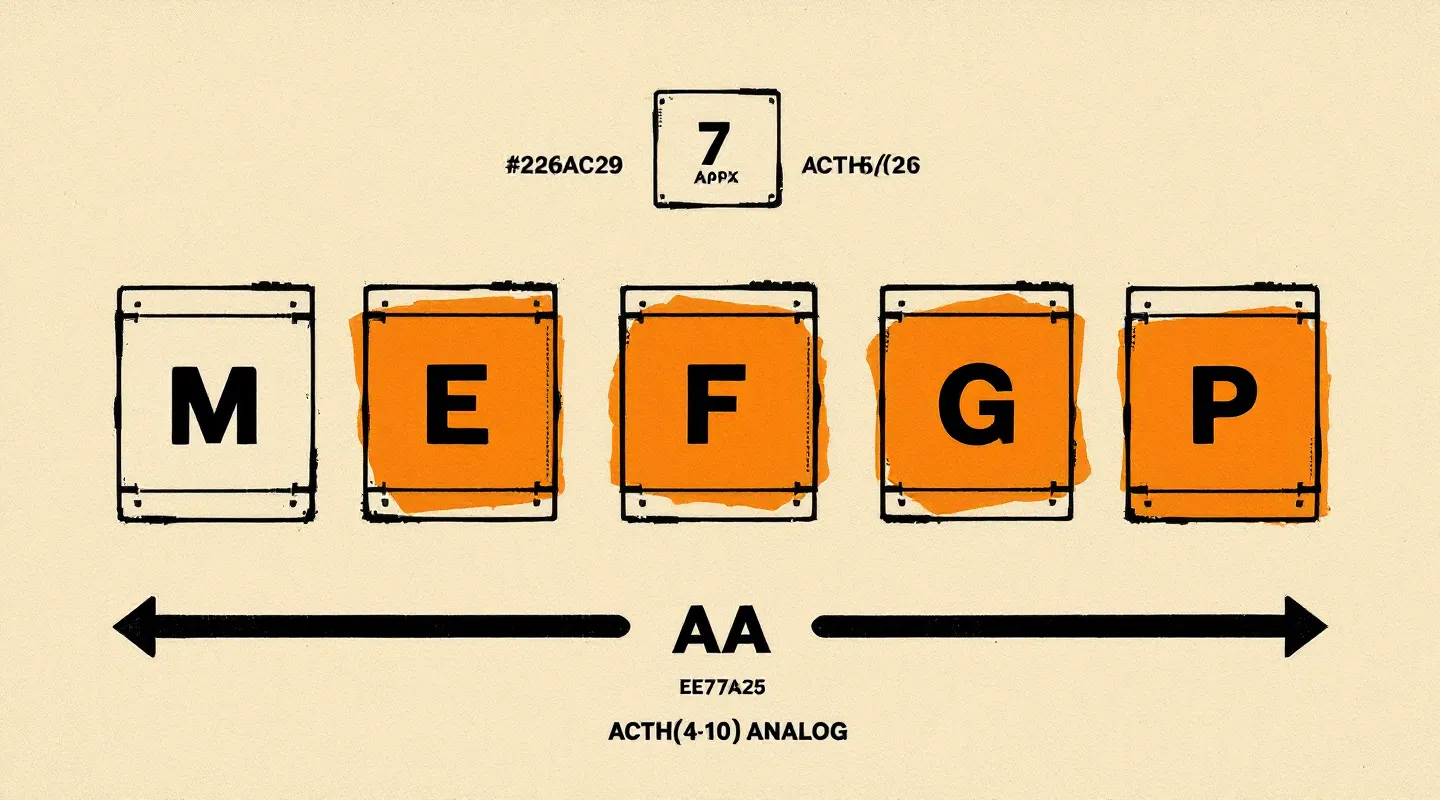
Semax is a synthetic heptapeptide with the sequence Met-Glu-His-Phe-Pro-Gly-Pro (MEHFPGP), molecular weight 813.93 Da. Its first four residues reproduce the ACTH(4-7) fragment of adrenocorticotropic hormone — the fragment that carries the behavioral and neurotrophic activity of ACTH without its steroidogenic effects. The terminal Pro-Gly-Pro tripeptide shields the parent fragment from rapid aminopeptidase degradation, extending its functional duration far beyond that of the intact peptide [12].
The molecule was developed in the 1980s at the Institute of Molecular Genetics of the Russian Academy of Sciences, in the laboratory of N.F. Myasoedov. Initial synthesis and pharmacological characterization were published in the early 1990s, and the compound entered Russian clinical use through the Gusev and Skvortsova neurology programs at the Russian State Medical University. On 7 December 2011, Semax was added to the Russian Federation's List of Vital and Essential Drugs in two formulations — Semax 0.1% intranasal drops for nootropic and cognitive indications, and Semax 1% intranasal drops for acute neurological indications including ischemic stroke.
Outside Russia and Ukraine, Semax has no marketing authorization. It is not approved by the United States Food and Drug Administration, the European Medicines Agency, the United Kingdom's Medicines and Healthcare products Regulatory Agency, or Health Canada. In the United States, the compound is sold by laboratory-reagent vendors as a research chemical for in-vitro use and cannot lawfully be prescribed, compounded, or dispensed for human consumption.
SECTION 02 / WHY THIS SITE EXISTS
The Semax literature occupies an unusual position in the peptide-research record. The compound has a registered prescription status in two countries, a published clinical record stretching back nearly thirty years, and a developing modern mechanistic literature in Western journals — and yet a US-based reader searching for an editorial overview tends to encounter either vendor marketing copy or short forum threads, with little in between.
Rx Semax indexes and stamps that peer-reviewed record for readers who want the regulatory and mechanistic literature laid out together. It represents no vendor, clinic, or manufacturer, and it offers no medical guidance. The 'Rx' in the domain name reflects Semax's prescription status in the Russian Federation and Ukraine and the register of a customs-stamped dossier — not any claim that Semax is or can be prescribed in the United States.
Where the source literature is Russian-language and the abstract or full text is paywalled in Western databases, the summary states so. Where a finding has been replicated in a Western-journal mechanistic study (Inozemtseva 2024 in European Journal of Pharmacology [10]; Liu 2025 in British Journal of Pharmacology [11]; Sciacca 2022 in ACS Chemical Neuroscience [12]), the citation makes that lineage visible.
SECTION 03 / WHAT THE RESEARCH SHOWS
Across seventeen indexed studies, the most consistent finding is upregulation of brain-derived neurotrophic factor (BDNF) and its receptor TrkB in the rat hippocampus, basal forebrain, and frontal cortex following intranasal Semax at 50 mcg/kg. Dolotov and colleagues reported a 1.4-fold increase in BDNF protein, a 1.6-fold increase in TrkB tyrosine phosphorylation, and an approximately three-fold increase in exon III BDNF mRNA in the rat hippocampus three hours after a single intranasal dose [1]. A companion study in the same year identified specific high-affinity binding (Kd ≈ 2.4 nM) to basal forebrain membranes and demonstrated regional selectivity of the BDNF upregulation [2].
In rat ischemia models, Semax produces a multimodal neuroprotective signature. After transient middle cerebral artery occlusion, intraperitoneal Semax at 100 mcg/kg increased active CREB more than 1.5-fold in subcortical ischemic structures, reduced active JNK more than 1.5-fold across cortex and subcortex, and downregulated MMP-9 expression approximately 1.5-fold in adjacent frontoparietal cortex [4]. A genome-wide RNA-Seq study identified 394 differentially expressed genes — predominantly suppression of inflammatory and immune-system transcripts and activation of neurotransmission-related genes, occurring 3 to 24 hours after the ischemic insult while penumbral tissue remained salvageable [6].
The Russian clinical record centers on Gusev and colleagues' open-label trial in 30 patients with acute hemispheric ischemic stroke. Intranasal Semax at 12 mg/day for moderate strokes (five-day course) and 18 mg/day for severe strokes (ten-day course) was associated with accelerated regression of general cerebral and focal motor deficits compared to 80 control patients receiving conventional therapy alone, with parallel improvements on EEG mapping and somatosensory evoked potentials [3]. A recovery-phase study reported elevated plasma BDNF and improved Barthel-index and MRC motor-scale scores in 110 post-stroke patients receiving 6,000 mcg/day intranasally in two ten-day courses [14]. Both reports are Russian-language; the Western-language record is limited to mechanistic preclinical work.
SECTION 04 / HOW TO READ THIS SITE
Six sections sit behind the masthead, numbered as they appear in the nav. /research carries the mechanism and the indexed study summaries in detail. /dosage documents the doses, routes, and durations reported in the published research — preclinical microgram-per-kilogram ranges in rats, the Russian approved-label milligram-per-day ranges in humans — and frames every figure as research context, not clinical guidance. /faq answers the regulatory and mechanism questions that recur in the literature and in search queries. /references lists every cited paper with PMID, DOI, or full source URL, and flags the Russian-language sources explicitly. /about explains what this publication is, who it is not, and the editorial standards behind it. /contact is the page to reach the editor with corrections.
Four earth-palette accents organize the editorial categories across the site: sienna marks mechanism and molecular-biology content, teal marks indexed evidence and study summaries, magenta marks regulatory and jurisdictional caveats, and orange marks dosage and pharmacokinetic context. The stenciled section markers and ALL-CAPS eyebrow labels carry the same editorial grouping for readers who navigate without color.